


Concrete Pump
What is Concrete Pump
A concrete pump is a machine used for transferring liquid concrete by pumping. There are different types of concrete pumps. A common type of concrete pump for large scale construction projects is known as a boom concrete pump, because it uses a remote-controlled articulating robotic arm to place concrete accurately.
Benefits of Concrete Pump
Pumps offer more efficient concrete pouring
Speed is one of the most significant advantages pumps have over other methods of concrete pouring. Because the piston system works to send a steady flow of concrete through the hose, pouring concrete with a pump truck takes less time and labor than transport methods like wheelbarrows or concrete buggies. In optimal conditions, the whole pour process can take as little as an hour from start to finish.
The accuracy of pumps also saves time. Both boom and line pumps are more precise in pouring than traditional methods because their flexible extensions allow you to place the concrete exactly where you need it. With fewer errors, you'll be able to produce cleaner work faster and spend less time cleaning up mistakes.
Additionally, by integrating the mixing truck with the pump system, concrete pump trucks save you the time you would have spent waiting for the next concrete batches to be ready.
Pumped concrete is stronger
To effectively pour concrete through a chute, you need wetter concrete. The added water can compromise the strength of the concrete, leading to cracks and shrinkage later on. Ultimately, this means your final product will not be able to withstand as much pressure as it could if you'd used drier concrete.
Pumped concrete contains less water than chute-poured concrete. As a result, it can withstand higher amounts of force than chute-poured concrete and is less susceptible to cracking. Your projects will last longer and will need fewer repairs than if you were to use a more traditional mixer-to-chute method.
You can use a pump anywhere
ADY concrete pump can be used anywhere because they easily fit into any space
Concrete pumps can easily fit into any space, whether that be on the ground or in the air. Boom pumps in particular are great for hard-to-reach areas because they can extend over large structures like homes and landscaping.
Pumps will keep your projects moving
Setting up concrete pumps is quick and easy, requiring fewer employees and less equipment than other methods. After all, you need people to build a chute before you can even begin pouring. You only need two people to operate a pump — one to watch the hose and another to work the controls. And once they're ready, concrete pumps have a high capacity per hour.
Concrete pumps are also safe to use even in rough weather or dark conditions. You can finish tasks on days when you previously would have had to take a break. A pump's durability and consistent flow mean you'll experience fewer delays in construction and less downtime. The pressurized pouring process is much quicker than chute delivery, which relies on gravity to push the concrete down into the pour site. As a result, you'll have more time to focus on other aspects of your project.
Your construction site will be safer
Because pumps can extend over large areas, you can keep trucks and other large machinery out of the way of dangerous obstructions. Just park the truck, extend the hose wherever you need the concrete to go and start pouring. The piston-operated system will take care of the rest until your space is filled. Concrete pumps also require fewer people to operate, reducing site congestion and improving job safety and efficiency.
-
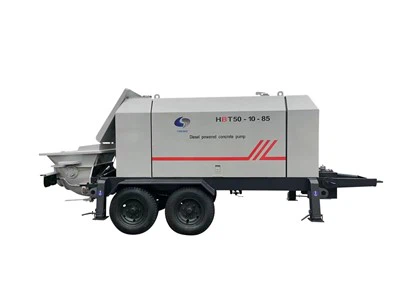 HBT50 Electric Concrete Transfer Pump For SaleThe HBT50 electric concrete transfer pump is an excellent addition to any construction site orAdd to Inquiry
 -
 Good Quality Diesel Power Concrete Pump OutletThe TOBEMAC hydraulic concrete pump is a fantastic piece of machinery that has revolutionized theAdd to Inquiry
 -
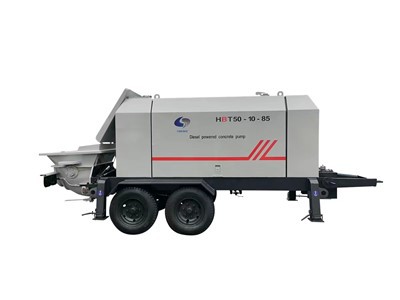 Hydraulic Power Concrete Transfer PumpDiesel power concrete pumps are a popular and widely used machine in the construction industry.Add to Inquiry
 -
 Diesel Powered Concrete Transfer Pumps From TOBEMAC For S...The HBT50 and HBT60 mobile concrete pumps are a great addition to any construction site thatAdd to Inquiry
 -
 HBT50 High Efficiency Construction Machinery Hbt50 Hbt60 ...The HBT50 and HBT60 mobile concrete pumps are a great addition to any construction site thatAdd to Inquiry
 -
 Concrete Pump With Mixing Factory Direct Sales Welcome Cu...If you are looking for a reliable and efficient solution to your concrete mixing and pumping needs,Add to Inquiry
 -
 Diesel Power Mixing Integrated Transfer Pump Factory Dire...If you are looking for a reliable and efficient solution to your concrete mixing and pumping needs,Add to Inquiry
 -
 Diesel Power Concrete Pump National Standard Steel Kawasa...Diesel power concrete pumps are a popular and widely used machine in the construction industry.Add to Inquiry
 -
 Concrete Drum Mixer Pump And Diesel Powered Electric Powe...Boom pressure concrete pump is an essential tool in the construction industry. It offers a quickAdd to Inquiry
 -
 Mini Portable C3 Concrete Pan Mixer Pump With DieselIf you are looking for a reliable and efficient solution to your concrete mixing and pumping needs,Add to Inquiry
 -
 TOBEMAC Diesel Powered Concrete Transfer Pump For SaleThe TOBEMAC hydraulic concrete pump is a fantastic piece of machinery that has revolutionized theAdd to Inquiry
 -
 Concrete Transfer Pump With MixingIf you are looking for a reliable and efficient solution to your concrete mixing and pumping needs,Add to Inquiry


- Tel: +8618857919561
- Fax: +86-571-64142286
- Email: sales@tobemac.com
- Add: Hutang Industrial Park, Daciyan Town, Jiande City, Zhejiang Province, China
Why Choose us
Wide range of products
They offer a wide range of products, including concrete mixer truck, concrete boom pump, concrete batching plant, and other heavy construction machinery and equipment.
Experienced team
Their team members have years of experience in the construction machinery industry, and they have a good understanding of the needs and requirements of their clients.
Quality assurance
They have a strict quality control system and have achieved ISO 9001:2015 certification. Their products are tested at different stages of production to ensure quality and reliability.
Satisfied customers
They have served numerous clients from all over the world, and their customers are highly satisfied with their products and services.
Competitive prices
They offer highly competitive prices for their products, ensuring that customers get the best value for their money.
Types of Concrete Pump
Stationary Concrete Pumps
Stationary concrete pumps have 3 types of pumping systems that vary according to the brand and specifications of each machine. The most commonly found are:
● Concrete Pump with “Rock Valve”. Generally used for working with a large stone or aggregate. The system consists of a valve shifting from cylinder to cylinder which pumps concrete through one outlet. Use of rotation through a kidney seal allows concrete output through a single opening.
● Concrete Pump System with Balls. These units are composed of two chambers separated by steel balls where concrete cylinders absorb pumped material then let it pass under pressure through the outlet.
● Concrete Pump with "S VALVE". Characterized for high-pressure pumping, concrete passes through a single valve through on these machines.
Boom Pumps and Concrete Pump Trucks
The most commonly used machines on large projects are Boom Pumps, especially where you need to place concrete in hard-to-reach locations. You can find these units in various types and sizes in meters according to the needs of each construction job. The most common are:
● Concrete Boom Trucks: Comprised of a large truck with a pump mounted on board, this pump has a powerful pump kit for maximum efficiency and speed of work.
● Line pump: You can move this portable pump throughout the work. It is most common for pumping grout, mortar, sludge and other construction materials.
● Stationary Pump: Mostly used for placing concrete in areas that are difficult or impossible to reach with a boom truck. These are large pumps mounted on a strong frame and are used to pour large amounts of concrete over long distances.

What Are Common Concrete Pump Parts?
The main pump circuit
The primary pump circuit is one of a concrete boom pump's most crucial parts. This circuit controls the parallel hydraulic drive cylinders and features the following components.
● Piston pump: The main hydraulic power pump gets its power from a variable displacement axial piston pump complete with a swashplate design. Adjusting the swashplate angle changes the stroke length of the pistons, and this process changes the concrete displacement. The more flow, the larger the swashplate angle becomes. Operators can adjust the swashplate angle using the load sense feature and the volume control.
● Motor: An engine or electric motor powers the main hydraulic pump. When the engine operates like usual, the pump switches off, minimizing the pressure on the pump and providing enough power to keep the pump lubricated.
● Valve manifold: A valve on the main circuit controls flow, the relief valve, the check valve and the pilot-operated directional valve.
Throttle control: To energize the pump circuit, the operator sets the speed to maximum RPM using the throttle control.
● Cycling circuit: Once the pump switches on, it immediately triggers the cycling circuit. This circuit generates an electrical signal and activates the directional valves.
● Material cylinders: The two parallel cylinders alternately pump the concrete. Proximity sensors trigger the material pumping action, sending the signal from the sensors to the logic controller.
● Relief valve: This valve protects the primary pump circuit from extreme pressure. When the system pressure reaches the maximum allowed, the relief valve opens to let oil return to the tank.
The s-tube shift circuit
This circuit controls the function for shifting the S-tube from one cylinder to the other during pumping. As there's a single outlet for pumping material, there must be a method to transfer concrete from the cylinder to the outlet and then onto the delivery line.
The hopper has an S-tube to ensure task completion. There's one S-tube for two cylinders, so it must be easy to shift from one cylinder to another. We can explain this circuit by considering each of the following components.
● Tandem pump: To meet pressure and flow requirements, a tandem pump installed in a single section of the shift circuit connects to the main hydraulic pump, which drives it.
● Manifold block: Just like the main hydraulic circuit, there are manifold blocks in the shift circuit.
The auxiliary circuit
The agitator's hydraulic function is part of the auxiliary unit. The circuit controls the operation of the agitator and other additional equipment.
The agitator rotates to mix the concrete in the hopper and feed the cylinders. The tandem pump on the main circuit serves the auxiliary circuit. A solenoid cartridge or dump valve is a safety mechanism to prevent flow to the auxiliary circuit when the operator activates the emergency stop circuit.One of the most significant functions of the auxiliary circuit is to assist in pumping concrete high in the air and over long distances. The main components of this system include the following.
● Elbow with wear-detecting holes: These holes in the concrete pump elbows consist of quench casting material. They smooth the ready-mixed concrete flow and increase safety and durability.
● Outrigger: This component hangs at an oblique angle and widens the overhanging area for more significant stable movement.
● U-shaped bottom of the hopper: This part facilitates the initial movement of the liquid concrete from the hopper into the intake port. Cleaning is more accessible due to the efficient flow of the ready-mixed concrete, as it reduces the remaining volume.
● Power-operated vacuum pump: This battery-powered vacuum pump minimizes pulsation and discontinuity in concrete flow. This component creates a more homogeneous mixture.
The spraying arm
The spraying arm positions the concrete flow at the correct location. Telescopic elevation platforms and scaffolding are unnecessary, as the component can spray for distances up to 56 feet. The spraying head mixes concrete, elevators and air. The nozzle dimensions and overall design are vital for ensuring minimal rebound and correctly incorporating the concrete.
The air compressor
The air compressor gives the concrete the kinetic energy to spray and compact. A specific velocity is necessary for shotcrete to impact the site's surface, achieved with the compressor's airflow and the correct nozzle diameter.
The additive pump
The accelerator meets the requirement for early strength development by speeding up the hardening of the concrete. The dosage depends on the concrete flow at all times. A synchronized dosing device, combined with the concrete pump, performs this function.
The motorized chassis
The motorized chassis transports the concrete pump to the desired location. The chassis design is crucial, as it needs to be able to turn in relatively small spaces and operate on uneven terrain.
The control panel and remote control
The control panel allows for ease of operation and confirms the condition of the ready-mixed concrete inside the hopper. Operators can control the pumping speed based on the operation's needs. The digital display indicates when to perform maintenance checks or replacements.
Operators can use a remote control to manage the spraying process on site. Remote controls can be wireless or work via a cable connection and organize all the concrete components from one convenient location.
Pipe systems
Concrete pipes help contractors process concrete for projects, transfer it to work sites and deliver it to facilities safely and efficiently. Twin wall pipes are durable and specially designed for heavy-duty jobs. A twin wall pipe features a steel outer wall and a resistant inner lining that prevents corrosion and hardening. These features protect concrete and prevent it from hardening, allowing it to flow properly during distribution.
Hoses
Concrete pump hoses pump thick and abrasive substances such as concrete. A pump hose is durable and uses high pressure to pump concrete efficiently and safely. Their durability resists corrosion so you can complete jobs without inflicting damage.
Clean-out balls and ball catchers
Sponge foam clean-out balls are also important cleaning components because they help clear residue from the inside of pipes and hoses. After pumping concrete, you can use clean-out balls to clear debris, residue and remaining cement from the inside of concrete pump hoses. Clean-out balls have a parting stretch that enables them to move through narrow spaces without sustaining damage.
You also need a ball catcher when cleaning pipes. A pump pipeline might propel a clean-out ball, and you need something to stop it from flying across a work site. Remove the pump hose before securing the catcher and ensure the ball catcher fits the pipeline precisely.
Clamps and gaskets
Concrete pump clamps connect and secure hoses to concrete pump boom pipes. Always use a pump clamp with a gasket to seal a hose and boom pipe connection.
Hose pans
A hose pan reduces friction during pumping. Hoses can form bare patches when they surge forward and backward on the ground, but hose pans reduce friction to help the outer surfaces of hoses remain intact and last longer.
Safety straps
Fit a concrete pump hose with a safety strap to keep it lifted and prevent it from falling. Ensure safety straps are in good condition to prevent them from malfunctioning or breaking. Purchase new durable safety straps if you notice your current straps are worn or damaged.
Reducers
A reducer is a pipe that can adjust to a smaller size. Reducers connect larger-diameter pipes to smaller-diameter pipes, which lessens flow. Using a high-quality reducer can help you achieve a steady stream for concrete pumping.
Application of Concrete Pump
Concrete pump: Applications
Slab construction foundations
Flat concrete slabs serve as the foundations for buildings that do not have basements. An impermeable, level base is essential. Concrete pumps are necessary for efficient and accurate placement of the material. That way, you may be certain that the base is flawless.
Construction of basements
The foundation-laying procedure is more involved for structures with basements. Boom pumps and other types of concrete pumps are essential for completing a job on schedule and preventing mistakes or the concrete from setting up prematurely. The use of boom pumps in basement foundations speeds up the drying process and keeps the construction on schedule.
High-rise structures
Due to its height and reach, a boom pump is frequently required while working with high-rise structures. Using boom lifts, construction firms can efficiently and securely transport concrete to higher levels for further pouring, keeping projects on time.
Tunnels and overpasses on highways
The daily tons of traffic passing over highway overpasses need the use of strong materials like reinforced concrete. As with any underground structure, roadway tunnels need to be robust enough to withstand the pressure of the ground above them. The application of a concrete pump, and particularly a boom pump with its extra lift, may speed up and simplify the construction of structures like overpasses and tunnels, which typically need operating at an elevated level.
Construction of bridges and dams
For both vehicular traffic and high water pressure, bridges and dams need to be massive and solid. Concrete may be pumped swiftly to the top of a high-rise bridge or dam using a boom pump, which has the benefit of being able to raise and extend.
Parking facilities
It is difficult to transport concrete to the top levels of a parking garage without the use of a concrete pump since parking garages often consist of many floors. The use of a concrete pump makes it possible to finish the building of a large parking structure fast and without wasting any time or effort on manual work.
Sidewalks and driveways
Many people who are building a house pay the greatest attention to the structure itself. The driveway and walkway are also quite important. While some homeowners may be persuaded to do the job themselves, the best approach to ensure a level, sturdy, and fully cured driveway or pavement is to hire a professional construction business that has access to a concrete pump.
Ground-level swimming pools
A concrete slab, like a basement, serves as the basis for an in-ground pool. In order to efficiently build a backyard pool, concrete pumps, particularly boom pumps, are invaluable tools. Nobody likes the idea of a big truck rumbling through their backyard. However, a boom pump will effortlessly pour concrete from the street right over their heads.
Patio foundations and garden shed bases
Concrete pumps, such as boom pumps, are used for laying the groundwork for a variety of structures, including backyard swimming pools, patios, and garden sheds. The concrete platforms for these extensions may be poured with ease using boom pumps that can extend into the property from the street.
Concrete Pump: What to Look for When Buying One?

Purpose of a concrete pump
The intended use of the concrete pump should be fully realised. If, for instance, a purchased concrete pump is unsuitable for use in the project because it cannot be utilised to fill the tunnel's midsection, the pump is useless. Thus, before making a purchase, the responsible contractor or builder should ensure that the concrete pump in question is both flexible and highly functional.
Cost and economic aspects
The chosen concrete pump has to be cost-effective and appropriate for the total expenditure. Don't take the risk of paying too much for a low-quality concrete pump. Picking a concrete pump is always best done by comparing prices and results. Examine the quality and cost of each option.
About Us
Hangzhou Tob Engineering Machinery Co.,Ltd.,is one of the professional manufacturers of construction and engineering equipment in China. Situated in Jiande City, Hangzhou, which is about 100 kilometers away from Yiwu and 250 kilometers away from Ningbo Port, we enjoy an advantageous geographical location. The history of our manufacturing in construction machinery can be traced back to 1991. In 2008, the foreign trade department has been established and our goods started to be exported abroad. In 2016, we moved to the new factory in Jiande City, which covers an area of about 20000 square meter. We are very confident to enlarge our business scope in the brand new factory.
As a rapidly growing company specializing in the design and production of an extensive range of equipment in construction and engineering industry, we could supply you with products as follows: Concrete Mixer, Concrete Mixing Plant, Concrete Block Making Machine, Concrete Mixing Truck, Concrete Pump, Site Dumper, Wheel Loader, Small Crane, Tower Crane, Construction Lifter, Vibratory Roller, Light Tower, Plate Compactor,Tamping Rammer, Power Towel,Concrete Cutter, Concrete Vibrator ,Water Pump , Rebar Bender, Rebar Cutter and so on.

Certificate
To win more customer, we would like to give the following preferable policy:
OEM/ODM orders and customer's design are welcome.
No minimum order limit.
One-year quality warranty.

Asked Questions
As one of the leading concrete pump manufacturers and suppliers in China, we warmly welcome you to wholesale high quality concrete pump at competitive price from our factory. Good service and cheap products are available.
mix and go concrete mixer, 140liter portable concrete mixer, fiori concrete mixer