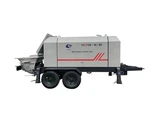
Concrete mixers can be classified into various types based on different criteria. Commonly, there are three main types: drum mixers, forced mixers, and pan mixers. The following is a detailed introduction to each type:
Drum Mixers
Working Principle: Drum mixers are equipped with a rotating drum that contains blades or paddles. As the drum rotates, the blades pick up and drop the concrete materials, causing them to mix through a combination of tumbling and folding actions.
Advantages: They are simple in structure, reliable in operation, and suitable for mixing general - purpose concrete. They are often used in small to medium - sized construction projects and are relatively cost - effective.
Disadvantages: The mixing efficiency is relatively low, and it may not be able to achieve a high - degree of homogeneity for some complex mixes or those with high - performance requirements.
Application Scenarios: Commonly used in general building construction, such as residential and commercial building projects, as well as in some small - scale infrastructure projects like rural road construction.
Forced Mixers
Working Principle: Forced mixers use a set of rotating blades or arms in a stationary mixing chamber to force the concrete materials to mix. The blades move at high speeds, creating a strong shearing and mixing action that ensures a more thorough and uniform blend of the ingredients.
Advantages: They have a high mixing efficiency and can achieve a high degree of homogeneity in a short time. They are suitable for mixing high - strength concrete, concrete with special additives, and large - volume batches.
Disadvantages: They are more complex in structure and require more maintenance compared to drum mixers. They also consume more power.
Application Scenarios: Widely used in large - scale infrastructure projects such as high - speed railway construction, bridge construction, and large industrial plants. They are also preferred in precast concrete manufacturing plants where high - quality and consistent mixes are required.
Pan Mixers
Working Principle: Pan mixers consist of a circular pan - shaped mixing container and one or more rotating mixing arms. The mixing arms move in a circular path within the pan, pushing and mixing the concrete materials. Some pan mixers may also have a tilting mechanism for easy discharge.
Advantages: They offer good mixing quality and can handle a variety of materials and mix ratios. They are relatively gentle on the materials, which is beneficial when dealing with fragile or sensitive aggregates.
Disadvantages: They have a relatively lower mixing capacity compared to some large - scale forced mixers, and the mixing speed may be slower.
Application Scenarios: Often used in situations where a high - quality mix is required but the volume is not extremely large, such as in some specialized construction projects, decorative concrete production, and in laboratories for small - scale testing and research.